
Meaning of the term Sephardic
This Jewish community is also called Sephardic, and the term was often used to distinguish them from Ashkenazi Jews of Central European, German or Russian origin. The term Sephardic comes from Sefarad, which the Bible used to designate Spain, as stated in the Book of Obadiah: The multitude of the deportees from Israel will occupy Canaan as far as Sarepta. And the deportees from Jerusalem who are in Sefarad will occupy the cities of the Negev, referring to the captivity of the Jews in Babylon, and their dispersion after the destruction of Jerusalem in the year 586 B.C.E. From the 2nd century C.E., the Spanish Jews named the Iberian Peninsula as Sefarad, a term that is still used to this day.
Who are the Sephardim
The name Sephardim is given to the Jews who lived in Spain until 1492. According to some researchers, the Jewish presence in Spain is very old, as demonstrated by some archaeological finds such as a Phoenician ring found in Cadiz in the 7th century BC, as well as an amphora from the 1st century, found in Ibiza, on which some Hebrew symbols appear. During the so-called Punic Wars in which Rome and Carthage faced each other in 264 BC, the Jews of today’s Spain suffered a considerable increase, as Rome took over the Hispanic territory. This would happen centuries later with the conquest of Judea by the Roman emperor Vespasian from the year 69. During the Diaspora, nearly eighty thousand Jews from Palestine arrived in Hispania.
Later, when the Visigoths, a Germanic people who conquered Hispania, converted to Catholicism thanks to Recadero I (559-601) through the Third Council of Toledo, discrimination and persecution of the Sephardim began, and their quality of life became extremely difficult, which is why they considered the invasion of the Arabs as a liberating event. At this time, the aljamas (group of Jews or Moors) and the Jewish quarters (Jewish neighborhoods) began.
With the victory of the Berber Tariq ibn Zyad, general of the Nafza (name of a Berber tribe belonging to the Burt) in Hispania, and the beginning of the Muslim era in the Peninsula in 711, the Jewish quarters grew and the Jews enjoyed relative social tranquility. The most important was the Andalusian community, which boasted of its good organization and high cultural level. Many of these Jews learned Arabic, which they used as a common language, and became civil servants and businessmen, which allowed them to occupy important positions and amass good fortunes. During this Muslim period, the Sephardim flourished culturally, and excelled in both the arts and sciences: astronomy, mathematics, medicine, architecture, philosophy…
The Sephardic Diaspora
The exile of the Sephardic Jews occurred in the year 1492, by strict order of the Kings of Spain: Isabel I of Castile and Fernando II of Aragon, at the end of the war of Granada, which ended Arab rule in Spain. In Granada, the decree for the expulsion of the Jews was signed. It was drawn up by the general inquisitor Tomás de Torquemada. He presented the fact that they endangered the Catholic faith of the converted Jews who had already existed since 1391 as the main reason for the departure of the Jews. The real reason was deeper and of an economic and political nature, not only for Spain but for the new states that were being formed in Europe. When the Sephardim left Spain, they took with them the language they spoke, Judeo-Spanish, the Castilian that was spoken in the 15th century. They sold their property at a bad price and were forbidden to take gold and silver out of Spanish territory. The conditions of their departure were appalling. Many of them settled in North Africa, others opted for Portugal, Navarre or the Italian states. But when they were expelled from Navarre, they went to Bayonne. In 1497, those who had opted for Portugal had to convert to Catholicism and some decided to emigrate to the Netherlands and northern Europe. Other Sephardic groups went to the Ottoman regions of the Balkans and the Near East. The Sephardim who did not want to leave Spain had to convert to Christianity and were baptized; among them were the most educated and wealthy Jews. The number of Jews who participated in the Diaspora varies according to each researcher, but ranges from fifty thousand to one hundred thousand.
The first Sephardic Jew to set foot on American soil
The first Sephardic Jew to set foot on American soil was Yosef Ben Halevy Haiva, whose converted name was Luis de Torres, originally from Moguer, Huelva. He arrived accompanying Christopher Columbus, because, as he himself claims, he spoke several languages that would be useful to them when they found the Ten Lost Tribes of Israel upon reaching China. But they did not reach China, but instead: We landed on the island of Guanahaní, which Columbus named San Salvador, and we took possession of those lands for Castile and Aragon, as Mr. Torres confirmed. When Columbus returned to Spain in 1492, Torres stayed in the settlement called La Navidad de La Española, which was later disappeared by indigenous rebels incited to renounce the Catholic faith by Torres himself, who had converted, with reluctance, to Catholicism.
Throughout the colonial period, many “new Christians,” converts, arrived in New Spain, despite the fact that an edict from the Catholic Monarchs prohibited their emigration to America, as did King Manuel of Portugal in 1499. The Jews who arrived were known as “crypto-Jews,” Christian Hebrews, converts, and Portuguese. From 1528, all those who arrived from Holland and Spain were called Portuguese Jews. What the expelled went through until they reached their destinations is a long history of suffering that also speaks to us of a profound faith and an almost unlimited strength. This is how the Sephardic Diaspora was formed. A Diaspora within another Diaspora that reached the New World. (Cf. La revista Sefarad)
The first Sephardim in New Spain
The excellent researcher Luis Weckmann in his book The Medieval Heritage of Mexico, informs us that: The Judaizers, that is, those who secretly practiced the Mosaic religion, were numerous in the Colony from 1580, the year in which Portugal (from where they had not been expelled until then) was annexed to Spain. Nevertheless, there were famous cases of crypto-Judaism from the beginning of the 16th century, such as that of Hernando Alonso, a collaborator of Cortés in the construction of the brigantines and encomendero of Actopan, who was burned in Tlatelolco in 1528. In 1539, the crown reiterated the prohibition of the “children and grandchildren of a burned or reconciled Jew, Moor or convert” from crossing to the Indies; nevertheless, many Jews gradually settled in New Spain, especially in the large cities.
Thus, from the early years of the 16th century there were Sephardic Jews from Portugal settled in New Spain, who were considered Hispanics given the annexation of Portugal to the Spanish kingdom. Many of them ended up in the Inquisition for being “marranos”… or not. That was the case of Nuño Méndez, who was accused of incest in 1538, with the chief inquisitor being Friar Juan de Zumárraga. Another Sephardic Jew mentioned was García González Bergemero, who arrived in New Spain in 1559. He was accused of being a marrano and was arrested and sentenced to be garroted and burned in the auto-da-fé of October 11, 15479. He was unable to escape despite his denial of the accusations and having confessed that some of his relatives continued to celebrate the rites and ceremonies of the Jewish religion.
Luis Carvajal y de la Cueva was born in Portugal in 1539 and died in Mexico City fifty-two years later. A New Christian of Portuguese origin, he was one of the conquistadors and governor of the New Kingdom of León from 1580 to 1588. He lived in Seville, where he married Giomar Ribera, and shortly afterward he went to America, where he was mayor of Tampico. It was not until his second trip to New Spain that he was named governor of the New Kingdom of León, where he lived with his sister, his brother-in-law, and his nephews; among them was Luis Carvajal, nicknamed El Mozo, who would become the first Jewish writer in America. Everything was going well for Carvajal, but in 1590 he was accused before the Inquisition of being a Judaizer (practitioner of Jewish rites and ceremonies) despite claiming to be a Christian. Found guilty, he was sentenced to six years of exile, but while awaiting sentencing he died from the atrocious torture he received. His relatives were burned at the stake. Thus, Carvajal El Viejo was one of the first Sephardic Jews to be known in 16th century New Spain. The information obtained about him is due to the records of the Inquisition.
The Sephardim of the Altos de Jalisco
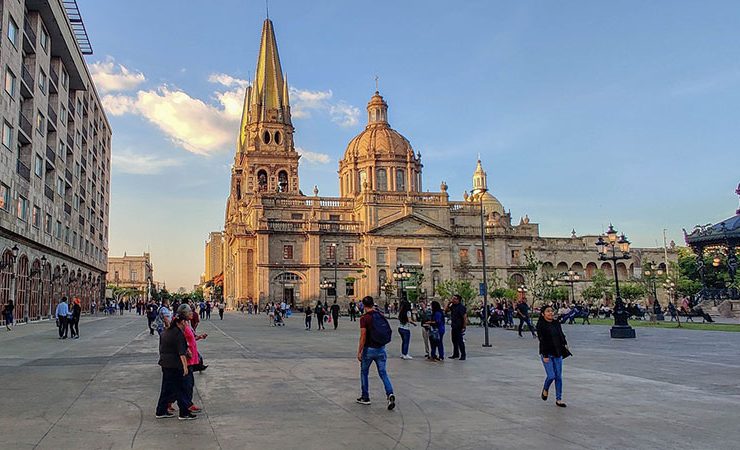
Little by little, the Sephardim settled in New Spain, as stated above. Thus, after the annihilation of the natives in the famous battle of Mixtón, fought between Chichimeca groups and conquistadors, many Spanish and Jewish-converted families settled in the area of New Galicia. The first settlements occurred in Atotonilco el Alto and in Teocaltiche. The Audience of Guadalajara distributed grants among the settlers. Many of the founding families that arrived came from Seville, others from the two Castillas and from Extremadura.
With the passage of time, the families lost their religion, or as the Diario Judío states: However, it is essential for the subject to establish defined reasons why the people of El Alto lost their Judaism. Initially, we have to recognize the distance factor, because in the first settlements the families were dispersed in small nuclei (during the 16th century), their religious life within the family being really ignored (there is no data on this), since their Catholicism was publicly manifest. The above is very understandable for the current Jew who was born in a mixed marriage -Jewish man/woman with Catholic man/woman-, since usually neither of the parents pressures the religious aspect, giving the children a “Catholic” image on the street, but feeling Jewish internally, especially in the Latin American countries where the pressure of a predominantly Catholic society discriminates (even unconsciously) against those who are not of their faith.
Hence, many descendants of Sephardic Jews, not only from Jalisco but from Guanajuato, Michoacán and other states, have lost the religion of their ancestors, and do not even know that a drop or two of Sephardic blood runs through their veins.
___________________________
Source: Komoni.mx